Hardware for the Agentic Era: Apple M5 vs Nvidia Blackwell
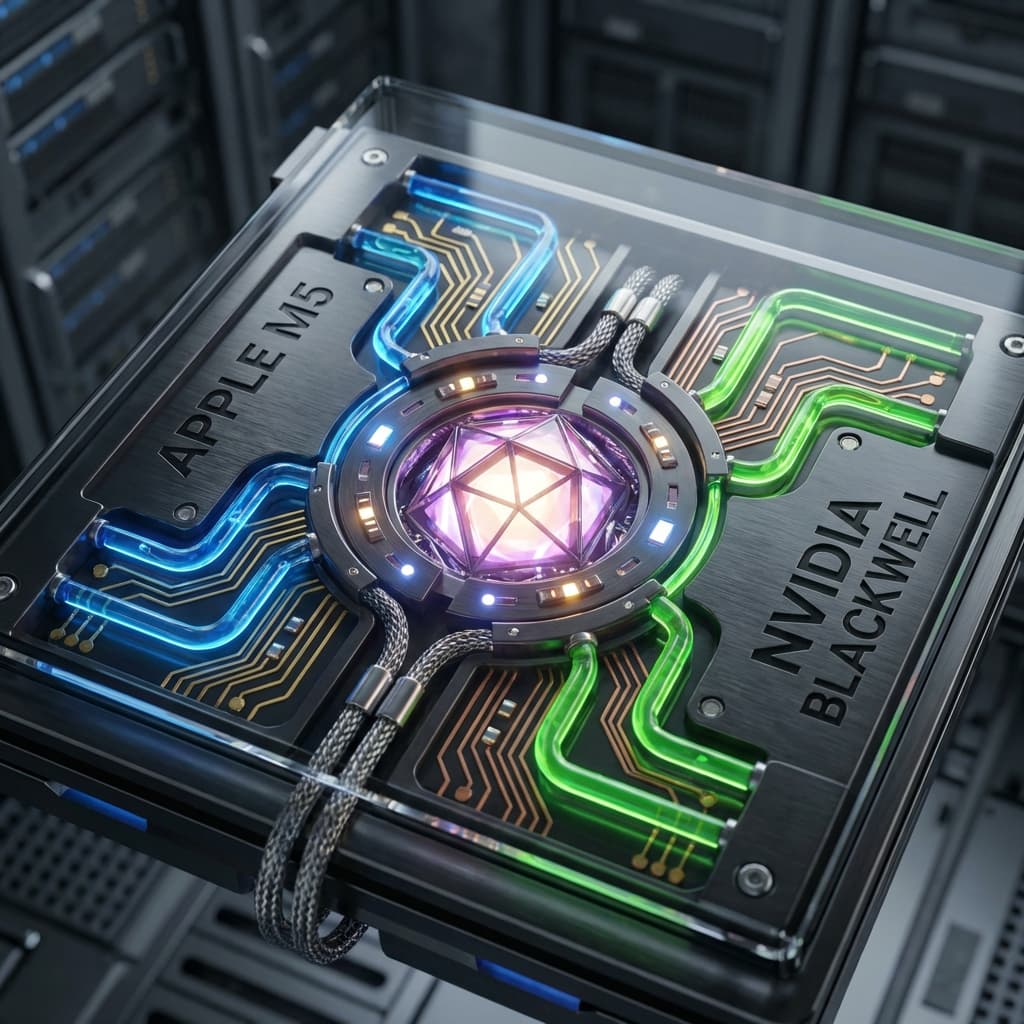
Inference is King
For the last 5 years, the hardware war was about training. Who can build the biggest cluster? But in 2026, the war has shifted to inference. Running millions of agents requires low-latency, high-memory bandwidth at the edge. This is where the battle is being fought, and the release of Meta's 600B-parameter Llama 5 in April only raised the stakes: open-weight frontier models now exist that genuinely need serious hardware to run well, and the question of "whose silicon do I buy" has real dollar consequences attached to it.
Apple's Unified Memory Advantage
The M5 Ultra with 256GB of unified memory allows developers to run massive quantized models (like Llama 4 70B, and increasingly aggressively-quantized slices of Llama 5) entirely in RAM — the workflow we walk through step by step in Digital Sovereignty. It's the ultimate dev machine for a single power user. Apple's bet on unified memory architecture (UMA) turned out to be the perfect move for the LLM era, because the bottleneck for local inference was never raw compute — it was memory bandwidth and the ability to hold a large model's weights without shuttling them across a PCIe bus.
The tradeoff is scale. A Mac Studio is fantastic for one developer running one model at a time, but it doesn't parallelize the way a server rack does. If your use case is "give every engineer on the team their own private local assistant," M5 hardware is close to unbeatable on cost and privacy. If your use case is "serve 10,000 concurrent agent sessions," it isn't the right tool at all.
Nvidia's Blackwell at the Edge
Nvidia isn't sleeping. Their "Jetson Thor" and Blackwell-based workstation cards are bringing data-center class inference to the desk. They excel at batch processing — running dozens of agents in parallel, each with its own KV cache, sharing the same physical GPU pool efficiently. If Apple is for the single powerful assistant, Nvidia is for the agent swarm: a QA team running 50 automated test-writing agents overnight, a research pipeline scoring thousands of documents in parallel, or a SaaS company serving inference to paying customers at scale.
The practical decision point for most engineering teams comes down to concurrency. Below roughly 5-10 simultaneous inference sessions, unified-memory Apple Silicon usually wins on total cost of ownership and simplicity. Above that, Blackwell-based infrastructure starts to pull ahead on throughput per dollar, especially once you're running quantized Llama 5 slices or serving customer-facing traffic that can't tolerate the queuing you'd get from a single Mac Studio.
The Groq Factor
We can't ignore the LPU (Language Processing Unit) players like Groq. While not general-purpose GPUs, their ability to deliver extremely high tokens-per-second throughput makes them essential for real-time voice and video agents where latency, not raw model size, is the product requirement. A customer-facing voice agent that needs to respond in under 300ms end-to-end simply cannot afford the queuing latency of a shared GPU cluster, and this is exactly the niche LPU hardware has carved out.
A Simple Decision Framework
| Your Use Case | Best Hardware Fit |
|---|---|
| Single-developer local coding assistant | Apple M5 (Pro/Max/Ultra) |
| Self-hosted Llama 5 for a small team | Nvidia Blackwell workstation or rack |
| High-concurrency agent swarm (50+ parallel sessions) | Nvidia Blackwell / Jetson Thor cluster |
| Real-time voice or video agent | Groq LPU or equivalent |
The hardware landscape is diversifying precisely because the workloads are diversifying. There is no longer a single "best chip for AI" — there's a best chip for your specific concurrency, latency, and privacy requirements, and the smartest infrastructure teams in 2026 are the ones benchmarking their actual workload rather than chasing whichever chip has the biggest headline number.
The Cost Side of the Equation
Hardware decisions in 2026 are rarely made on raw capability alone — the total cost of ownership over an 18-24 month window matters just as much. An Apple Silicon workstation is a fixed capital cost with essentially zero marginal cost per inference beyond electricity, which makes it easy to budget and easy to justify to a CFO. A Blackwell-based server cluster has a much higher upfront cost but amortizes far better across a large team or a customer-facing product, where the per-inference cost keeps dropping as utilization climbs. Groq and other LPU providers, meanwhile, are mostly consumed as a hosted service rather than purchased hardware, which shifts the cost conversation from capex to a very predictable opex line that scales with usage.
The mistake we see most often is a team buying data-center-class Blackwell hardware for a workload that's really just "five engineers each wanting their own coding assistant" — a problem far better and more cheaply solved with individual M5 machines. The inverse mistake is just as common: a startup trying to serve thousands of customers off a single Mac Studio because it worked great in the prototype phase, and then being surprised when concurrent request queuing destroys their latency SLAs the moment real traffic arrives. Matching the hardware tier to the actual concurrency profile of your product, not the concurrency profile of your dev environment, is the discipline that separates teams with a sane infra bill from teams that are quietly over- or under-provisioned.
Frequently asked questions
Is Apple Silicon or Nvidia better for running local AI models?
It depends almost entirely on concurrency. Below roughly five to ten simultaneous inference sessions, unified-memory Apple Silicon usually wins on total cost of ownership and simplicity, because the bottleneck for local inference is memory bandwidth rather than raw compute. Above that, Blackwell-based infrastructure pulls ahead on throughput per dollar since it can batch many agents against a shared GPU pool. A Mac Studio does not parallelize the way a server rack does.
What hardware do I need to run a large open-weight model locally?
For the smaller open-weight tiers, a well-specified unified-memory Mac or a single workstation GPU is enough, and quantization does most of the work. Frontier-scale open weights are a different problem: a 600-billion-parameter model needs server-grade memory and multi-GPU bandwidth to run at usable speed, so it targets self-hosted servers and multi-GPU workstations rather than a laptop. Match the model tier to the hardware you actually have before benchmarking anything.
Why would I use a Groq LPU instead of a GPU?
Because for real-time voice and video agents the product requirement is latency, not model size. LPUs deliver very high tokens-per-second throughput, which is what you need when a customer-facing voice agent has to respond end to end in a few hundred milliseconds and cannot absorb the queuing latency of a shared GPU cluster. They are consumed mostly as a hosted service, which also shifts the cost conversation from capital expenditure to a predictable usage-based line.