Breaking Cloud Dependence: The Case for On-Device Local AI
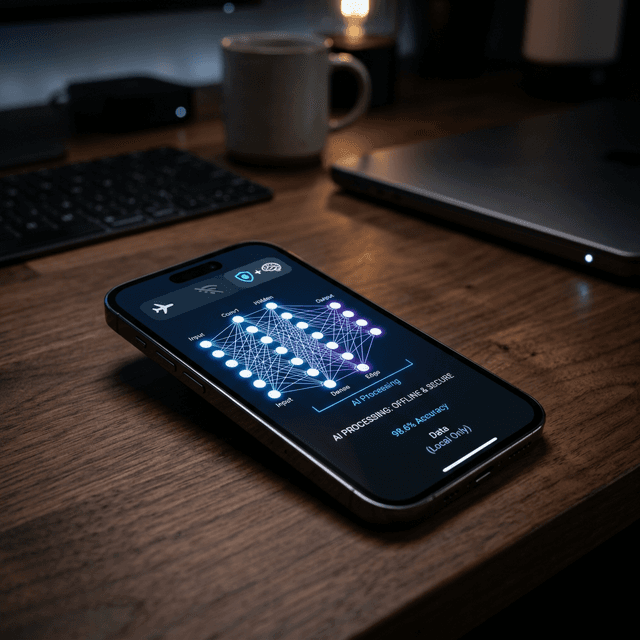
A Brain That Doesn't Stop Working Offline
The era of sending every request thousands of kilometers to a cloud server and waiting for a round trip is ending. As neural processing units (NPUs) inside phones, laptops, and watches have gotten dramatically more capable, heavyweight deep-learning workloads are moving onto the device itself — true local edge computation, with no network hop required.
The Rebellion of Small Models (sLLMs)
Instead of hundred-billion-parameter giants, quantized and pruned models in the single-digit-billions of parameters are now delivering startlingly strong performance. Efficient small models can generate on the order of 100 tokens per second directly on a phone in someone's pocket, with no cloud server involved at all. Google's Gemini 3.5 Flash-Lite, generally available as of mid-2026, is a good example of the category: a genuinely small, fast model purpose-built for exactly this kind of constrained, low-latency deployment, rather than a scaled-down afterthought of a larger flagship.
The Ultimate Privacy Infrastructure
When a model analyzes your private messages, sensitive financial details, or personal photo library entirely on-device, none of that data ever crosses a network boundary. That's a fundamental shift in the security model, not just an incremental improvement. Local AI is quickly becoming the "unhackable-in-transit" intelligence layer for both enterprises and individuals — there's simply nothing to intercept, because nothing left the device.
Where the Trade-Offs Still Bite
| Factor | Cloud AI | On-Device AI |
|---|---|---|
| Model size / capability ceiling | Effectively unlimited (frontier models) | Bounded by device memory and thermal limits |
| Latency | Network round-trip (50-300ms typical) | Near-instant, no network hop |
| Privacy | Data leaves the device | Data never leaves the device |
| Offline availability | None | Full functionality |
| Cost per query at scale | Ongoing API/inference cost | One-time hardware cost, amortized |
The honest framing is that on-device AI isn't replacing cloud AI — it's taking over the enormous share of everyday requests (quick lookups, transcription, translation, simple summarization) that never needed a frontier-scale model in the first place, freeing the cloud tier for genuinely hard reasoning tasks.
A Practical Example
Consider real-time translation during a conversation. Round-tripping every sentence to a cloud model adds enough lag that a natural back-and-forth conversation becomes stilted. A local sLLM running entirely on the NPU can translate with sub-100-millisecond latency because there's no network hop to wait on — the difference between a usable feature and a gimmick often comes down entirely to where the model runs, not how smart it is.
What's Next
Expect the split to sharpen further over the next year: frontier reasoning models like GPT-5.6 Sol or Claude Fable 5 handling the genuinely hard, high-stakes queries in the cloud, while a new generation of efficient on-device models — following the pattern set by Gemini 3.5 Flash-Lite — absorb everything routine, instant, and private. For most people, most of the time, the AI that actually touches their data will increasingly be the one running in their pocket, not in a data center.
The Enterprise Angle
Regulated industries are pushing this trend harder than consumers are. A hospital system piloting on-device transcription for patient intake doesn't need a frontier model — it needs a small model that never sends a recording off-premises, satisfying HIPAA requirements by architecture rather than by contract language. The same logic applies to law firms handling privileged documents and banks handling account data: the compliance department's favorite AI feature is the one it never has to worry about, because the data physically never left the building. That's turning "runs entirely on-device" from a nice-to-have into a procurement requirement in several regulated sectors.
A Simple Buyer's Checklist
- Does the feature actually run without a network connection, or does it just feel fast because of a good connection?
- Is there a written guarantee that raw input (audio, images, documents) never leaves the device, or only a guarantee about the output?
- How does the model degrade under real thermal and battery constraints, not just in a demo?
- What happens for the harder 10-20% of requests that the on-device model can't handle well — is there a clearly disclosed cloud fallback, and can you turn it off?
None of these questions require a technical background to ask, and any vendor that can't answer them plainly is telling you something important about how seriously they take the "on-device" claim in their marketing.