Digital Sovereignty: Why Your Next AI Will Live on Your Mac
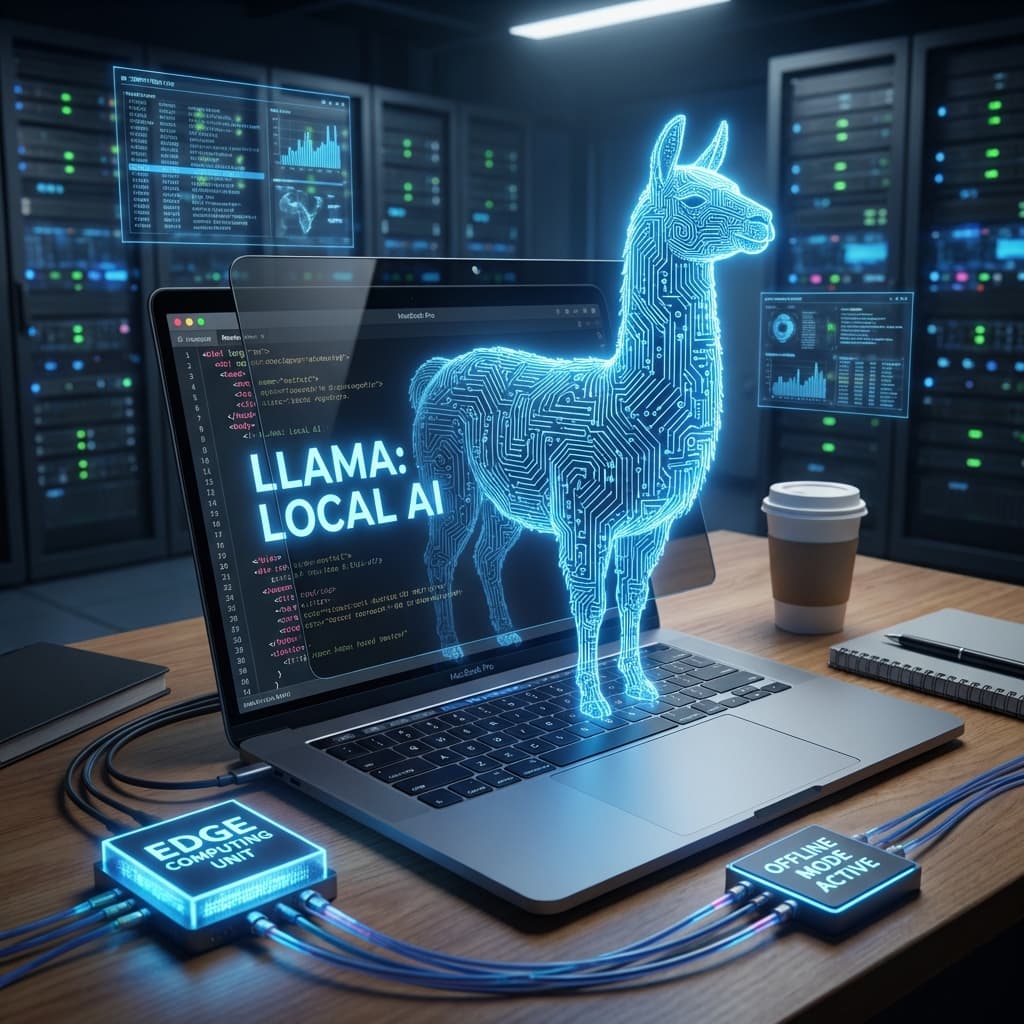
The Edge Revolution Is Already Here
For the past three years the assumption inside almost every AI product team was the same: the smartest models live in a hyperscaler datacenter, and your job as a developer is to talk to them through an API. Through early 2026 that assumption collapsed. Meta's Llama 4 (the 8B "Mini" and 70B "Pro" variants), combined with Apple's M5 silicon and a new generation of open inference runtimes, pushed local AI past the "good enough" line for the majority of day-to-day knowledge work. The 8B model matches the original GPT-4 on most benchmarks. The 70B variant is closing in on Claude 3 Opus. And both run, comfortably, on hardware sitting on your desk.
Update, July 2026: Meta has since raised the ceiling again. On April 8th, Meta shipped Llama 5 — a 600-billion-parameter open-weight model with a 5-million-token context window — alongside Muse Spark, the first closed, natively multimodal model from Meta Superintelligence Labs. Llama 5 is a genuine frontier-class open-weight release, but at 600B parameters it is not a laptop model in the way Llama 4's 8B and 70B variants were; it targets self-hosted servers and multi-GPU workstations rather than a MacBook. For the "local-first on your Mac" use case this article is about, Llama 4's smaller variants remain the practical workhorse, while Llama 5 opens up a new tier of self-hosted frontier capability for teams running their own GPU infrastructure. We've kept the original Llama 4 benchmarks and workflow below intact since they remain accurate for on-device use, and added a new section below on where Llama 5 fits.
This article is a working developer's tour of what this shift actually means. We will look at the benchmarks that matter, the runtime choices, the new "local-first" application stack that is emerging on top of these models, and the categories of product where running locally is now a clear win versus where the cloud still rules. By the end you should have enough context to decide whether to ship your next feature against a paid API endpoint or a model file living in ~/.ollama.
What Changed: Benchmarks vs. Vibes
The popular narrative for local LLMs has historically been "close enough, but not quite there." That framing is out of date, though the honest version is less dramatic than the headlines. On the public knowledge, coding, and reasoning benchmarks, Llama 4 8B now lands in the same band as the original GPT-4 (March 2023 release) — near-parity rather than a clean sweep, with the ordering flipping depending on which evaluation harness ran it and when the snapshot was taken. On a MacBook Pro M5 with the standard 36GB unified memory configuration it generates comfortably faster than you can read. The 70B variant, quantized to 4-bit, is noticeably slower on the same machine — behind streaming from Anthropic's API, but still comfortably interactive. Throughput swings with quantization, context length, and available unified memory, so the only figure worth acting on is the one you measure on your own hardware with your own prompts.
Numbers in isolation are misleading. The lived experience matters more, and three properties of local inference change what kinds of apps you can build:
- Latency is bounded by your machine, not the internet. Time-to-first-token on Llama 4 8B running locally is close to instantaneous — there's no TLS handshake, no routing hop, and no queueing behind other tenants between your prompt and the first token. A round-trip to a hosted endpoint, even one geographically close, always adds a perceptible delay on top of that. The gap is the difference between a chat that feels alive and one that feels remote, and it shows up on every single turn.
- Throughput is constant. No rate limits. No backoff. No surprise 529s during a US business-hours traffic spike. If you want a 24/7 background agent watching your filesystem or your inbox, you can finally have one without a finance conversation.
- Cost decouples from usage. Once the hardware is purchased the marginal cost of inference is electricity. For workloads with high token volume — RAG pipelines, batch summarization, agentic loops that revise drafts dozens of times — this is the only economically sane path. If you haven't priced out what those loops cost against a hosted API, our breakdown of token economics is a sobering read.
Why "Local Wins" Is Not the Whole Story
It would be dishonest to pretend the cloud is finished. There are still three areas where hosted frontier models clearly dominate:
- Frontier reasoning. If you need the absolute best one-shot reasoning on a hard problem — research-grade math, novel code architecture, complex legal analysis — Claude Fable 5.1 and GPT-5.6 Sol are still measurably ahead. The gap is shrinking quarter over quarter, but it is real.
- Multimodal breadth. Native audio and video understanding, real-time voice, and image generation at production quality still live in cloud-hosted stacks. Local equivalents exist (Whisper for ASR, SDXL Turbo for images) but the integration and quality gap is significant.
- Massive context windows. A 1M-token context with reliable retrieval is something hosted providers have invested heavily in — Google's Gemini Pro tier in particular has made long-context work its signature capability. Local models nominally support large contexts but quality degrades sharply past ~32K tokens on consumer hardware.
Laid out side by side, the trade is easy to reason about:
| Factor | Cloud AI | On-Device AI |
|---|---|---|
| Capability ceiling | Effectively unlimited (frontier models) | Bounded by device memory and thermal limits |
| Latency | Network round-trip adds a perceptible delay | Near-instant, no network hop |
| Privacy | Data leaves the device | Data never leaves the device |
| Offline availability | None | Full functionality |
| Cost per query at scale | Ongoing API cost, scales with usage | One-time hardware cost, amortized |
The right framing isn't "local replaces cloud." It is: local now handles the 90% of work where latency, privacy, or cost matters more than peak intelligence, and cloud is reserved for the hard 10%. The interesting architecture question is how to route a request between the two.
Choosing a Runtime: Ollama vs. LM Studio vs. llama.cpp
If you are running a local LLM in 2026, you are almost certainly using one of three runtimes. They all wrap the same underlying inference engine (a descendant of llama.cpp), but the developer experience differs sharply.
Ollama
Best default for engineers. One command with Ollama (ollama pull llama4) gets you a running model exposing an OpenAI-compatible HTTP API on localhost:11434. Drop-in replacement for OpenAI SDK calls — change the base URL and you are done. The model library is curated, quantizations are sane, and the new "agent mode" lets you persist a model in memory across requests for sub-100ms warm latency.
LM Studio
Best for non-engineers and rapid prototyping. GUI for browsing, downloading, and chatting with models. Now ships with built-in RAG over local folders and a server mode that mirrors Ollama's API. The "Apple Silicon optimized" builds squeeze noticeably better throughput out of M-series chips than vanilla Ollama, at the cost of being slightly fiddlier to script.
llama.cpp directly
Best for embedded scenarios — shipping a model inside a desktop app, a Raspberry Pi, or a server you control. You give up convenience for total control: custom sampling, custom quantization, custom batching. If you are building a product, you almost certainly want this under the hood eventually, even if you prototype on Ollama.
A practical heuristic: prototype on Ollama for the first week. Switch to LM Studio if your team includes non-developers who need to test prompts. Move to llama.cpp when you are ready to ship and need to control binary size and inference behavior.
The Local-First Application Stack
Beyond raw inference, an entire stack is forming around the assumption that the model runs on the user's machine. The components, as we are seeing them deployed in real products:
- Local vector database. Chroma, LanceDB, or sqlite-vec for the smallest deployments. They store embeddings on disk, search in milliseconds, and never talk to a network. Chroma is the default for Python projects; LanceDB is the right pick for cross-language and serverless edge use.
- Local LLM. Llama 4 (8B for speed, 70B for quality), Mistral Small 3, or Qwen 3 14B for code-heavy tasks.
- Local embedding model. nomic-embed-text or BGE-Large running through the same Ollama process. Embedding inference is fast enough that you can re-embed your entire knowledge base nightly on a laptop.
- UI shell. Either a desktop app (Tauri or Electron) or a browser-based PWA that talks to
localhost. Some teams are experimenting with WebGPU-based runtimes that ship the entire stack into the browser itself, but quality is still a step behind native runtimes.
Three Product Categories Where Local Already Wins
1. Developer tooling
Code never leaving the machine is a hard requirement for an increasing number of enterprises. A local-first IDE assistant — code completion, refactoring, test generation, doc lookup — is now genuinely competitive with the cloud offerings on quality, and uncompromised on privacy. Several of the tools in the VibeStack directory already ship optional local backends. Expect this to be table stakes by end of 2026.
2. Personal knowledge management
Anything that needs to read your email, calendar, journal, or notes belongs on the device. The product category we are calling "smart filing cabinet" — local index, semantic search, AI summarization, on-device chat over your own history — is exploding, and every winner so far has been local-first by design.
3. Voice and accessibility
Real-time, always-on voice transcription with sub-100ms latency is a fundamentally different product when it works without sending audio to the cloud. Whisper Large v3 turbo plus Llama 4 8B on a single M5 machine is enough to run a meeting assistant that produces searchable, summarized notes without anything leaving the room.
Below the Laptop: NPUs, Phones, and the Small-Model Tier
Everything above assumes a Mac with 36GB of unified memory. The more interesting frontier is one tier down, on the neural processing units now shipping inside phones, tablets, and watches. Instead of hundred-billion-parameter giants, quantized and pruned models in the single-digit billions of parameters — the category people have started calling sLLMs — deliver startlingly strong performance for their size. An efficient small model can generate text directly on a phone in someone's pocket fast enough to feel instantaneous in a chat interface, with no server involved at all. Google's Gemini 3.5 Flash-Lite, generally available as of mid-2026, is the clearest example of the category done deliberately: purpose-built for constrained, low-latency deployment rather than a scaled-down afterthought of a larger flagship.
The canonical demonstration is real-time translation. Round-tripping every sentence to a cloud model adds enough lag that a natural back-and-forth conversation becomes stilted and people give up on it. A local sLLM running on the NPU translates with sub-100-millisecond latency because there is no network hop to wait on. The difference between a usable feature and a gimmick comes down entirely to where the model runs, not how smart it is — which is the same argument as the rest of this article, just with a smaller memory budget.
Expect the split to sharpen over the next year. Frontier reasoning models handle the genuinely hard, high-stakes queries in the cloud, while a new generation of efficient on-device models absorbs everything routine, instant, and private. For most people, most of the time, the AI that actually touches their data will be the one running in their pocket or on their desk, not in a data center.
Why Regulated Industries Are Pushing This Harder Than Consumers
The loudest demand for local inference isn't coming from privacy enthusiasts. It's coming from compliance departments. A hospital system piloting on-device transcription for patient intake doesn't need a frontier model — it needs a small model that never sends a recording off-premises, satisfying HIPAA by architecture rather than by contract language. The same logic applies to law firms handling privileged documents and banks handling account data: the compliance team's favorite AI feature is the one it never has to worry about, because the data physically never left the building. Where the alternative is a cryptographic pipeline — see our piece on zero-knowledge AI and confidential computation — simply running the model locally is often the cheaper way to reach the same guarantee.
That is turning "runs entirely on-device" from a nice-to-have into a hard procurement requirement in several regulated sectors, which in turn is what's funding the small-model research. If you're building for those buyers, the local path isn't a cost-saving measure; it's the only path.
Where Llama 5 Fits: Frontier Open Weights, Not a Laptop Model
Meta's April 2026 Llama 5 release is a different animal from the 8B and 70B variants this article is built around. At 600 billion parameters with a 5-million-token context window, it's a genuine frontier-class open-weight model — the kind of release that used to only come from closed labs — and it shipped alongside Muse Spark, Meta Superintelligence Labs' first closed, natively multimodal model. For self-hosted teams with a multi-GPU server or a rented cluster, Llama 5 is a serious alternative to a hosted frontier API, with the same core sovereignty argument: your data, your weights, your uptime.
What it is not is a MacBook model. Even aggressively quantized, 600B parameters need real server-grade memory and multi-GPU bandwidth to run at usable speed — this is not an ollama pull away from your laptop the way Llama 4 8B is. If your goal is "AI that lives entirely on my Mac," Llama 4's smaller variants remain the right tool. If your goal is "frontier-grade AI that lives entirely on infrastructure I control," Llama 5 is the new benchmark to evaluate against, and it's worth budgeting real GPU spend to test it against your specific workload before committing either way.
Where Cloud Still Wins (For Now)
Be honest with yourself: there are workloads where the local-first answer is "not yet." Frontier coding agents that need 10-step reasoning, large-context document analysis above 100K tokens, and any product where the user experience depends on the model being smarter than 95% of humans rather than 80% — these still belong on hosted endpoints. The right product architecture in 2026 is hybrid: cheap, fast, private local inference for the hot path, with cloud calls reserved as a fallback for the hardest queries.
If You're Buying Rather Than Building: A Four-Question Checklist
"On-device" has become a marketing term, which means a fair number of products claiming it are really just fast cloud products. Four questions separate the two, and none of them require a technical background to ask:
- Does the feature actually keep working with the network off, or does it merely feel fast because your connection is good?
- Is there a written guarantee that raw input — audio, images, documents — never leaves the device, or only a guarantee about the output?
- How does the model degrade under real thermal and battery constraints, rather than in a two-minute demo on a cool device?
- What happens on the harder 10–20% of requests the on-device model can't handle? Is there a clearly disclosed cloud fallback, and can you turn it off?
Any vendor that can't answer those plainly is telling you something important about how seriously to take the claim.
Getting Started This Week
If you want to feel the shift firsthand, the cheapest experiment is:
- Install Ollama (one command on macOS).
- Run
ollama pull llama4:8band wait for the ~4.5GB download. - Point your existing OpenAI-SDK code at
http://localhost:11434/v1with any string as the API key. - Run your evals or your favorite prompts. Note the latency.
You will discover, probably within an hour, that a meaningful fraction of what you currently pay an API for could be running on the laptop you are reading this on. That recognition is what we mean by Digital Sovereignty: the realization that the choice of where intelligence lives is now yours to make, not your provider's. The best AI stacks of the next two years are going to be built by teams who treat that choice as a first-class architectural decision rather than a default.
Further Reading
If this resonates, the related pieces on this site go deeper into the practical side: our breakdown of Apple M5 vs. Nvidia Blackwell for inference, the cryptographic route to the same privacy guarantee in zero-knowledge AI, the open-weight model landscape in the open source LLM revolution, and our tour of the AI tool directory with local-capable options filtered in. If you're weighing local against a hosted flagship for a specific workload, the Gemini 3 Pro deep dive lays out what the cloud tier still buys you. Most of all, try it: a weekend with Llama 4 on your own machine teaches more than any benchmark table.
Frequently asked questions
Can I actually run a good LLM on a MacBook?
Yes, and it is no longer a compromise for most everyday work. Llama 4's 8B variant is roughly a 4.5GB download and runs comfortably fast on Apple Silicon with unified memory, which is enough for chat, summarization, RAG, and most coding assistance. The 70B variant quantized to 4-bit is still interactive on a well-specced machine — slower than a hosted API stream, but usable. What you give up is peak reasoning on genuinely hard problems, not basic competence.
How much RAM do I need for a local LLM?
As a rule of thumb, budget slightly more memory than the model file itself, plus headroom for your context window and the rest of your operating system. An 8B model quantized to 4-bit fits comfortably on a 16GB machine. A 70B model at 4-bit needs a 36GB or larger unified-memory configuration to run without swapping, and swapping is what turns a usable local model into an unusable one. Memory bandwidth matters as much as capacity on Apple Silicon.
Can I run Llama 5 locally?
Not on a laptop. Llama 5 is a 600-billion-parameter open-weight model with a 5-million-token context window — genuinely frontier-class, but built for multi-GPU servers and workstations, not a MacBook. Even aggressively quantized it needs server-grade memory and interconnect bandwidth to run at usable speed. If your goal is AI that lives entirely on your own machine, Llama 4's 8B and 70B variants remain the practical choice; Llama 5 is for teams that want frontier capability on infrastructure they control.
Should I use Ollama, LM Studio, or llama.cpp?
Ollama is the best default for engineers: one command gets you a running model behind an OpenAI-compatible HTTP endpoint, so you can point existing SDK code at localhost and change nothing else. LM Studio is better if non-developers on your team need to test prompts through a GUI. Drop down to llama.cpp directly when you are shipping a product and need control over binary size, quantization, and sampling behavior. A practical path is to prototype on Ollama and migrate later.
Is a local LLM good enough to replace ChatGPT or Claude?
For a surprisingly large share of work, yes — anything where latency, privacy, offline availability, or token volume matters more than peak intelligence. Hosted frontier models still clearly win on hard one-shot reasoning, native multimodal breadth, and reliable retrieval across very large contexts. The architecture most teams land on is hybrid: local inference on the hot path, with a cloud call reserved as a fallback for the hardest requests.
Why do regulated industries care about on-device AI?
Because running the model locally satisfies a compliance requirement by architecture rather than by contract. A hospital doing on-device transcription, a law firm processing privileged documents, or a bank scoring account data does not have to negotiate a data processing agreement over data that never leaves the building. That is often cheaper and easier to explain to an auditor than a cryptographic pipeline, and it is a large part of why on-device has moved from a nice-to-have to a hard procurement requirement in several sectors.