Zero-Knowledge AI: Finally Ready for the Enterprise
The Privacy Wall Falls
For three years, enterprises have been stuck. They could see the transformational potential of AI, but they couldn't use it. "We can't send our patient data to OpenAI." "We can't put our financial models in the cloud." "Our contracts prohibit third-party AI access." These were the walls that kept AI out of the most valuable markets.
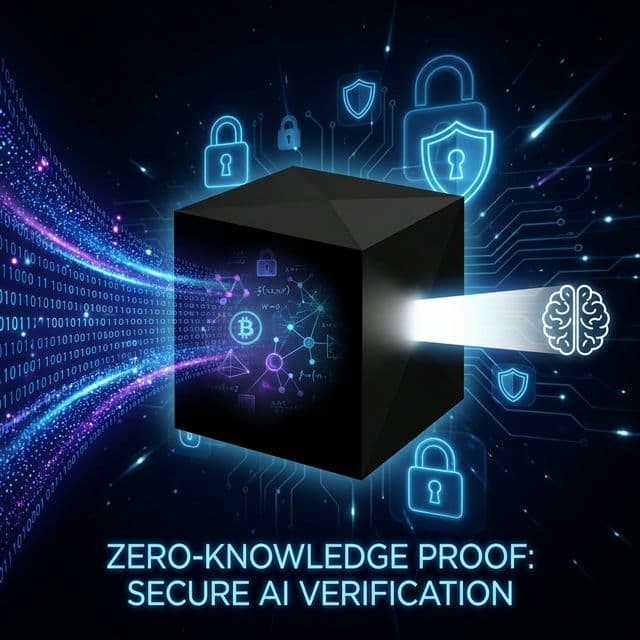
Zero-Knowledge AI (ZK-AI) just tore down those walls. Using a combination of homomorphic encryption, secure multi-party computation, and zero-knowledge proofs, it's now possible to run AI inference on encrypted data without ever decrypting it. The model never sees your secrets. You never see the model's weights. Yet you get intelligent outputs.
How It Actually Works
Here's the magic in plain English: Your data stays encrypted on your servers. You send encrypted queries to the AI service. The AI runs its model on the encrypted data using homomorphic operations—mathematical operations that work on ciphertexts and produce correct results when decrypted. The response is encrypted when it leaves the AI service and only decrypts when it reaches your system.
The zero-knowledge proof component verifies that the AI actually ran the model correctly—that it didn't cheat, use a simpler model, or tamper with the output. You get cryptographic proof of correct execution without learning anything about the model's internals.
The Healthcare Breakthrough
Mayo Clinic just announced they're deploying ZK-AI for diagnostic assistance. Doctors can query GPT-class models about patient symptoms, medication interactions, and treatment protocols without ever exposing PHI (Protected Health Information). The AI provides diagnostic suggestions without knowing who the patient is.
This is a trillion-dollar market unlock. Healthcare has been the biggest holdout in AI adoption due to HIPAA compliance requirements. ZK-AI makes compliance possible.
Financial Services Follow
JPMorgan and Goldman Sachs are piloting ZK-AI for fraud detection and risk analysis. They can now run proprietary trading algorithms against market data using AI-enhanced analytics without revealing their strategies to the AI provider. The competitive advantage is enormous—better models without information leakage.
The Performance Trade-Off
There's no free lunch. ZK-AI is 10-50x slower than standard inference and costs 5-10x more. But for sensitive use cases, that's acceptable. If the alternative is "no AI at all," then "slow AI" is infinitely better.
Hardware accelerators are improving rapidly. New ASICs designed specifically for homomorphic operations are cutting the overhead by 80% year-over-year. Within three years, ZK-AI will be just 2-3x slower than standard inference—practical for most applications.
The New Stack
We're seeing a new architecture emerge:
- Encrypted Vector DBs: Pinecone and Weaviate now support encrypted embeddings
- ZK-LLM APIs: OpenAI and Anthropic are beta-testing privacy-preserving endpoints
- Confidential Computing: Intel TDX and AMD SEV enable hardware-isolated inference
- Proof Verifiers: Light clients that verify AI outputs without re-running the model
Case Study: How One Insurer Uses ZK-AI Today
A mid-size health insurer we advised was blocked from using any hosted LLM for claims triage because every claim touches PHI. Under a zero-knowledge pipeline, the insurer's own servers encrypt claim narratives before they ever leave the building. The AI provider's inference cluster performs its forward pass entirely on ciphertext, returns an encrypted risk score, and the insurer decrypts locally. The provider never sees a diagnosis, a name, or a policy number — only mathematically opaque tensors. The insurer went from "no AI, full stop" to processing 40% of routine claims with AI-assisted triage in under two quarters.
Comparing the Privacy-Preserving Techniques
| Technique | What It Hides | Speed Penalty | Best For |
|---|---|---|---|
| Homomorphic Encryption | Input data and output data | 10-50x slower | Highly regulated single queries (diagnosis, legal review) |
| Secure Multi-Party Computation | Data shared across multiple parties | 5-15x slower | Cross-institution fraud detection |
| Confidential Computing (TDX/SEV) | Data at the hardware level | 1.1-1.3x slower | General enterprise workloads needing "good enough" isolation |
| Zero-Knowledge Proofs | Model internals / correctness of execution | Adds verification overhead, not inference overhead | Auditing that a vendor ran the model it claims to have run |
Most production deployments today mix these techniques rather than picking one. A typical enterprise stack encrypts data in transit and at rest with confidential computing for speed, reserves full homomorphic encryption for the most sensitive query types, and layers zero-knowledge proofs on top purely for audit trails.
What This Means for You
If you've been holding back on AI features because of privacy concerns, it's time to reconsider. ZK-AI makes it possible to offer intelligent features to the most regulated industries. The competitive moat for early adopters will be massive.