Swarm Intelligence: Inside the Rise of Autonomous AI Agent Collectives
The Age of the Solo AI Assistant Is Over
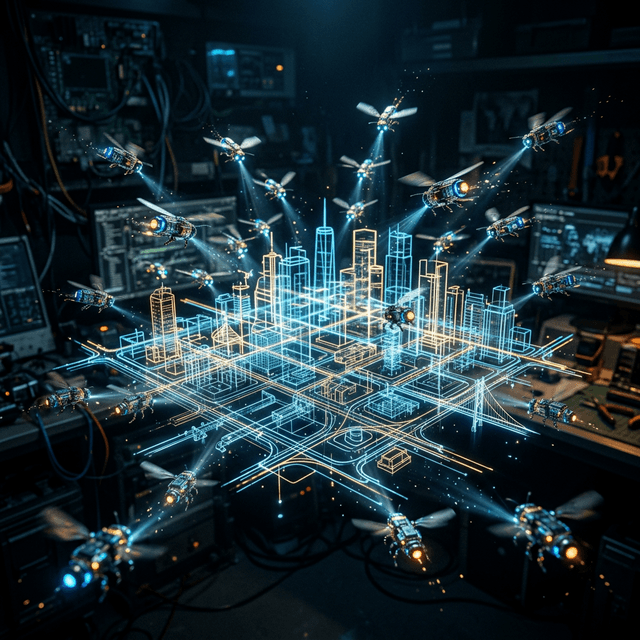
Not long ago, working with AI meant a single chat window and a one-on-one conversation. Today's "software company 2.0" doesn't run on a lone model answering questions — it runs on a multi-agent system: a mesh of specialized agents, each with a narrow job, coordinating with one another like a distributed team.
Inside an AI Agent "Office"
A project-manager agent breaks a ticket into subtasks. A frontend agent writes the implementation. A design-review agent checks the resulting layout against the spec. A QA agent runs randomized stress tests against the new code path. Meanwhile, a security agent scans the diff for vulnerabilities before anything merges. All of this happens without a human in the loop, with agents exchanging messages and state on a millisecond cadence.
A Concrete Example
Picture a real ticket: "Add CSV export to the reporting dashboard." The PM agent splits it into a backend export-endpoint task, a frontend button-and-download-flow task, and a QA task to verify large exports don't time out. The backend and frontend agents work in parallel, each posting progress updates to a shared task log. When the frontend agent finishes first, it doesn't wait idle — it starts writing tests against the backend agent's published API contract, catching a mismatched field name before the human reviewer ever opens a pull request. Total elapsed time: nine minutes, versus the ninety minutes a single sequential agent would have needed to touch every layer one at a time.
Why Swarms Outperform Solo Models
The most striking property of swarm intelligence is that these systems resolve problems no single model could handle alone, purely through collaboration. Agents challenge each other, leave review comments on one another's output, and iterate toward a better solution than any one of them would have produced independently. It's the same trick humans used to build civilizations out of individuals: organize into structures that compensate for any one member's blind spots. AI collectives are now doing the same thing to push past the ceiling of a single model's context and judgment.
The Tooling Catching Up to the Idea
Developer tools are adapting quickly to this shift. Cursor 3.11, released July 10, 2026, added a searchable archive of agent transcripts specifically so a team can review exactly which agent said what during a multi-agent run — a small feature, but a telling one: it treats a swarm's internal conversation as something worth auditing, not a black box to be trusted blindly. Cursor represents one end of the spectrum, where a human stays in the editor while agents work around them; Devin represents the other, where the agent owns the whole ticket. We compare the second approach in detail in our look at autonomous coding agents, and the rest of the category in the best AI coding tools roundup.
| Agent Role | Responsibility | Typical Failure Mode If Missing |
|---|---|---|
| Project Manager | Splits work, sequences dependencies | Agents duplicate or block on each other's work |
| Implementation | Writes the actual code/content | Slower single-threaded delivery |
| Reviewer/QA | Checks output against spec and edge cases | Bugs reach production undetected |
| Security | Scans for vulnerabilities before merge | Exploitable code ships silently |
| Integrator | Wires independent workstreams together | Components work individually but fail combined |
The Risk Nobody Talks About Enough
Swarms compound both good and bad behavior. If one agent's output is subtly wrong — an over-permissive security rule, a misread requirement — other agents can build on that mistake and propagate it faster than a human team ever would, simply because the whole swarm operates at machine speed. The teams getting the most value from agent swarms are the ones that also invested early in observability: transcript logging, checkpoint reviews, and clear rollback points, so a bad decision by one agent doesn't silently cascade through five others before a human notices.
Getting Started: A Minimal Swarm
You don't need five specialized agents on day one. Most teams that succeed with this pattern start with just two: an implementation agent and a reviewer agent that critiques the first agent's output before a human ever sees it. That alone catches a surprising share of obvious mistakes — missing error handling, an unused import, an edge case the spec didn't call out — for a fraction of the coordination overhead of a full swarm. Once that two-agent loop is trustworthy, teams typically add a QA agent third, then a security-focused agent fourth, growing the swarm one role at a time rather than standing up the whole "office" at once.
The sequencing matters because debugging a five-agent swarm that's misbehaving is genuinely harder than debugging a two-agent one — there are more possible places for a miscommunication to hide. Start small, prove out the observability tooling on a simple loop, and only then scale up the number of specialized roles. The observability layer is its own design problem, and a harder one than the orchestration: we work through it in designing interfaces for agent collectives.
Frequently asked questions
What is an AI agent swarm?
It's a set of specialized agents, each with a narrow role — planning, implementation, review, QA, security — that coordinate on a shared task instead of one general-purpose agent doing everything sequentially. The value comes from two things: independent workstreams can run in parallel, and agents can critique each other's output, which catches mistakes a single model would carry forward unnoticed.
Do multi-agent systems actually work better than one agent?
For work that decomposes cleanly into parallel parts with checkable interfaces, yes — the parallelism is real and the peer review catches a class of error a solo agent won't. For tightly coupled work where every decision depends on the last, a swarm mostly adds coordination overhead and more places for context to be lost between handoffs. The honest test is whether you could hand the same task to two humans working simultaneously.
How many AI agents should I start with?
Two. An implementation agent plus a reviewer agent that critiques its output before a human sees it captures a surprising share of the benefit — missing error handling, unused imports, edge cases the spec didn't mention — at a fraction of the coordination cost. Add a QA agent third and a security-focused agent fourth, once the two-agent loop is trustworthy. Standing up a five-role swarm on day one mostly buys you a debugging problem.
What are the risks of autonomous agent swarms?
Error propagation at machine speed. If one agent produces something subtly wrong — an over-permissive rule, a misread requirement — the others can build on it faster than a human team ever would, and the mistake is buried under five layers of downstream work by the time anyone notices. The mitigation is unglamorous: transcript logging, checkpoint reviews, and clear rollback points, so a bad decision can be located and reverted rather than archaeologically excavated.