Beyond the Smartphone: AI Wearables Strike Back
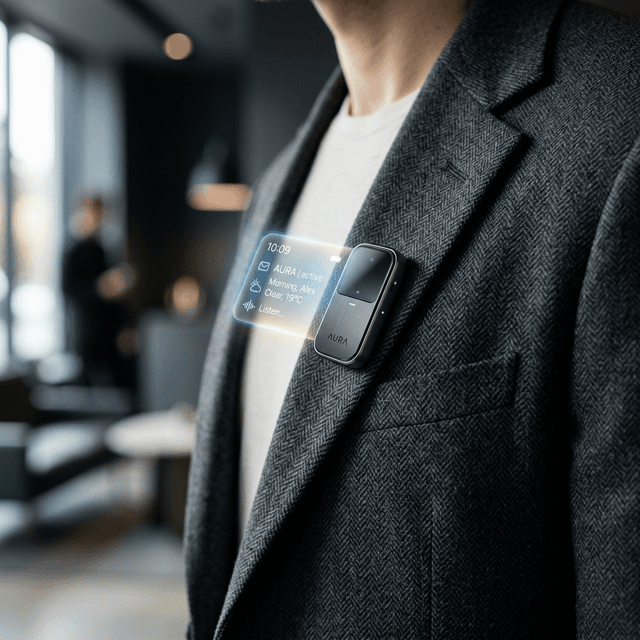
Breaking the Rectangle's Monopoly on Attention
For roughly fifteen years, our attention has been captured by a hand-sized rectangle of glass. A new wave of AI-powered wearables is trying to end that "tyranny of the screen" — not by building a better phone, but by removing the screen from the interaction entirely.
This article is about the form factor, not the assistant software. The argument that an AI layer can dissolve app boundaries has already been made — and shipped — on phones, which we cover in Apple Intelligence in iOS 26. What follows is the question that only appears once you take the screen away: which constraints are physics, and what do they force you to design differently?
The Arrival of Ambient Computing
Users no longer need to unlock a phone, find an app, and tap through menus. A lens and microphone clipped to a lapel perceive the wearer's environment continuously, in both vision and audio. It translates a conversation partner's language in real time, looks at the ingredients on a kitchen counter and suggests a recipe, and summarizes a dense meeting into a few bullet points — projected onto the wearer's palm as a laser readout, in Humane's version of the idea. The intent-based model underneath is the same one arriving on phones; what changes is how the request gets in and how the answer gets out.
The Constraints a Screenless Device Imposes
Take away the display and four constraints appear immediately, none of which a better model fixes:
- Output becomes linear. A screen lets you scan and skim; audio arrives one word at a time, so anything past a couple of sentences is worse than a glance at a phone. That forces aggressive summarization, which makes the summarizer's judgment — not the retrieval — the product.
- Disambiguation gets expensive. On a phone an ambiguous request becomes three tappable options; by voice it costs a full conversational turn, so the device is under pressure to guess. Guessing on irreversible actions is how these products lose trust, which is why the good ones stay read-only by default and confirm anything that spends money or sends a message.
- So does error correction. Fixing a wrong word is trivial with a keyboard and painful by voice. That asymmetry, more than accuracy, caps how much real work moves onto a screenless device.
- Power and thermals cap local compute. A device worn against the body has a battery measured in single-digit watt-hours and no room for a fan, which is why so much processing goes to a server and why latency is dominated by the network. Local models keep improving — see running models locally — but a lapel pin's thermal envelope is a far harder limit than a laptop's, and the silicon race is relaxing it only slowly.
There's a fifth, non-technical constraint: talking to a device in public has a social cost that tapping a screen doesn't. Every screenless product eventually collides with the fact that a phone's most discreet input method — silent typing — is the one a wearable can't offer.
Where the Category Actually Stands
The category has had a rocky adolescence. Humane's AI Pin was the highest-profile attempt and it didn't survive: reviewers were blunt about battery life, heat, and latency, and the company's assets were acquired by HP in 2025 with the Pin discontinued. What outlasted it is the interaction premise — the devices that followed kept the ambient, intent-driven model and attacked the physical problems: weight, thermals, and how long the thing lasts off a charger.
| Form Factor | Primary Sensor | Best Use Case | Biggest Limitation |
|---|---|---|---|
| Lapel pin | Camera + mic | Ambient translation, recipe/object lookup | Battery life, social awkwardness of a visible camera |
| Smart glasses | Camera + mic + display | Hands-free navigation, live captions | Weight, price, limited display brightness outdoors |
| Smart ring | Biometric sensors | Health tracking, silent notifications | No camera or voice interface at all |
| Pendant / clip audio device | Mic only | Meeting summarization, voice memos | No visual context, purely conversational |
Why This Time Might Be Different
The smartwatch-as-phone-replacement experiments of the 2010s failed partly because they tried to shrink a phone screen onto a wrist. This generation isn't attempting that, which is why serious hardware teams keep re-entering the category. The winning device probably won't resemble the phone it's replacing at all — and given the constraints above, it may not try to replace it so much as absorb the specific tasks the phone is worst at.
The Road Ahead
The near-term future likely isn't "one device to rule them all," but a layered stack: a phone still in your pocket as the compute and connectivity anchor, a lightweight wearable as the ambient interface, and an AI layer stitching both together so you rarely have to think about which one you're using. Whoever gets that handoff feeling right first will define the category the way the original iPhone defined the smartphone.
The Privacy Question Nobody's Fully Solved
An always-on camera clipped to your lapel isn't just a privacy question for the wearer — it's a privacy question for everyone standing near them. Restaurants, gyms, and offices have already started posting explicit policies about recording wearables, and some venues ban them outright. The manufacturers with the most credible answer so far combine a visible recording indicator (a small light that's genuinely hard to disable) with on-device processing that discards raw video the moment a summary or translation is extracted, so no permanent footage of bystanders exists at all. That distinction — "the device saw you briefly" versus "the device has a video of you forever" — is likely to become the dividing line between wearables that get banned from public spaces and ones that get accepted into daily life.
What to Watch For Before Buying
If you're evaluating one of these devices today, the questions worth asking are less about raw AI capability and more about the unglamorous fundamentals: How many hours does it actually last on a charge, under real use rather than a lab demo? Does it store your voice and video snippets locally, or does everything route through a server you don't control? And critically — can you actually return it if the ambient-computing promise doesn't match the reality once you're wearing it around your own life for a week? The category has burned early adopters before; the second and third generations are worth a much closer look than the first ones were.
There's also a cheap way to test whether you'd use one before spending anything on hardware. Most headline wearable use cases have a phone-based equivalent today — ambient meeting capture is what Otter.ai already does, and natural voice output is what ElevenLabs already does. Live with the software version for two weeks. If you stop reaching for it, no amount of industrial design will change that.
Frequently asked questions
Are AI wearables going to replace smartphones?
Not on current physics. A body-worn device has a single-digit watt-hour battery and no active cooling, which caps local compute and pushes most processing to a server, and voice output is linear where a screen is scannable. The realistic near-term shape is layered: the phone stays as the compute and connectivity anchor, and the wearable takes the specific tasks the phone is worst at — hands-free capture, translation, and ambient lookup.
What happened to the Humane AI Pin?
It was the category's highest-profile attempt and it didn't survive. Reviewers were consistently critical of battery life, heat, and latency, and Humane's assets were acquired by HP in 2025 with the Pin discontinued. The interaction premise outlasted the product, though: subsequent devices kept the ambient, intent-driven model and focused on the physical problems Humane shipped before solving.
Do AI wearables record everyone around you?
That's the unresolved question of the category, and it's a privacy issue for bystanders rather than just for the wearer. The most credible designs pair a recording indicator that's genuinely hard to disable with on-device processing that discards raw audio and video once a summary or translation is extracted, so no lasting footage of bystanders exists. The distinction between "the device saw you briefly" and "the device has a video of you forever" is likely to decide which wearables get accepted in public spaces and which get banned.
Why do screenless devices feel harder to use than a phone?
Because removing the display removes the cheap ways to recover from mistakes. On a phone, an ambiguous request can be resolved with three tappable options and a wrong word fixed with one tap; by voice, both cost a full conversational turn. That asymmetry in error correction — not model accuracy — is what limits how much real work moves onto a wearable, and it's why the better devices stay read-only by default and confirm anything irreversible.